When nails quietly change as part of adult physiology
Understanding nail strength through connective tissue balance
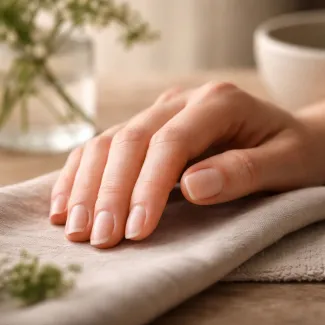
Nails that feel weaker and look less even are often interpreted as a surface issue, but for many adults after 30, this signal reflects a deeper, gradual shift in how the body maintains connective tissue quality. Rather than appearing suddenly, this change tends to unfold slowly, becoming noticeable only when everyday routines no longer produce the same visible results.
From an interpretative perspective, nails behave like a long-term logbook of internal balance. They grow slowly, respond late, and reveal patterns over time rather than instant states. This makes them especially sensitive to subtle changes in tissue renewal, structural proteins, and nutrient distribution that evolve with age.
The connective tissue axis behind nail strength
Why this signal exists at all
Nails are composed primarily of keratin, but their strength and smoothness depend on the surrounding connective tissue environment—the matrix that supports skin, microcirculation, and nutrient delivery. As adults move through their 30s and beyond, the body naturally prioritizes essential systems, while peripheral structures such as nails receive support more selectively.
This does not indicate dysfunction. It reflects adaptive physiology, where renewal becomes more strategic and less abundant. Over time, this can translate into nails that grow at the same pace but appear thinner, more ridged, or less uniform.
What gradually changes with age
Connective tissue renewal is influenced by structural proteins, hydration balance, and the body’s ability to maintain micro-level consistency. With age, the internal rhythm that once supported fast, even regeneration becomes more conservative. The result is not fragility, but variability—a hallmark of adult tissue behavior.
How this shows up in everyday life
Subtle patterns rather than sudden shifts
Most people do not notice one defining moment. Instead, they observe recurring details: nails that split more easily, surfaces that feel less smooth, or growth that appears uneven across fingers. These are not isolated flaws but part of a broader connective tissue narrative.
Pattern recognition over time
Common long-term observations may include:
- Inconsistent nail texture across weeks rather than days
- Increased sensitivity to environmental stressors like dryness
- Nails reflecting lifestyle intensity more clearly than before
- Slower visual recovery after periods of strain
These patterns matter more than any single change, because connective tissue responds cumulatively.
Systems quietly working in the background
Structural support rather than surface repair
The body does not “fix” nails directly. Instead, it sustains the structural network that allows nails to form predictably. This includes collagen frameworks, circulation at the nail bed, and the availability of building blocks distributed through daily intake and absorption.
For broader context on how adults often think about supporting their bodies at this stage of life, see
Best supplements for your 30s: Top 5 nutrients your body truly needs
How to respond in practical, everyday ways
Orienting daily choices around connective tissue support
Rather than focusing on quick corrections, it is more useful to think in terms of support, protection, and consistency.
What tends to support this system:
- Steady routines that respect recovery and regeneration
- Environments that limit repeated dryness or mechanical stress
- Habits that favor long-term tissue maintenance over rapid change
- Awareness of how nails respond over months, not days
What often overburdens it:
- Repeated cycles of stress and depletion without recovery
- Environments that exaggerate dehydration or friction
- Expecting nails to behave the same way they did earlier in adulthood
Thinking in rhythms instead of fixes
Connective tissue thrives on predictability. Adults who frame their daily decisions around rhythm—sleep, nourishment, movement, and rest—often notice that nails become a clearer reflection of internal balance rather than a constant concern.
For a deeper look at how structural proteins relate to tissue experience over time, including nails as part of the wider system, see
Collagen supplements and how skin elasticity and joints may feel with age
Long-term observation as a skill
One of the most effective responses is learning what to observe, not what to force. Nails provide feedback about how well the body is distributing resources. Changes that stabilize, even if not reversed, often indicate improved internal coherence.
Understanding how daily habits influence the body’s ability to use what it receives can also be useful. More on this perspective is available in
Boost Nutrient Absorption Naturally: Top Dietary & Lifestyle Tips
Living with the signal, not against it
Nails that feel weaker and look less even are rarely asking for correction. More often, they are communicating pace—a reminder that adult physiology values steadiness over speed. When interpreted this way, the signal becomes less about appearance and more about alignment with how the body now prefers to function.
In this context, understanding replaces urgency. The body is not losing capacity; it is redistributing attention. Nails simply happen to be one of the quiet places where that story becomes visible.